Age Bias Sucks
I'm not writing this as one of those rage-bait posts you see all the time — candidates complaining about how they got screwed in a recruiting process, or third-party recruiters complaining about a client who age-biased out a great candidate they put forward. That's not the point of this.
I'm writing this because I keep seeing the same thing happen, and I think candidates need to understand how to respond to it. I spend my days talking with hiring managers, CROs, founders, recruiters, and candidates. After a while, you start to see patterns.
The Screening Call
A great candidate told me recently that he made it into a screening call with a corporate recruiter for a role. Strong background. Exactly the type of experience the company said they wanted. The recruiter told him, "Sorry, we're only looking for sellers with three to five years of experience."
Three to five years.
Not "we found someone stronger." Not "the skills didn't line up." Just a number.
That's especially frustrating in sales, where the things that actually predict success — judgment, resilience, curiosity, the ability to navigate a room, and the ability to close — have very little to do with when someone was born. Think about what that number does in practice: you take a large group of qualified, capable candidates and eliminate maybe 25%-50% of them before anyone even looks at what they can actually do. Say that same sentence out loud about almost any other characteristic and everyone recognizes it instantly for what it is. With age, it somehow gets said on a screening call without a second thought.
"Years of experience" is often a lazy proxy. What people usually mean is, "Can this person operate the way this role needs to operate today?" That's not really an age question. It's a relevance question.
What You Can Actually Control
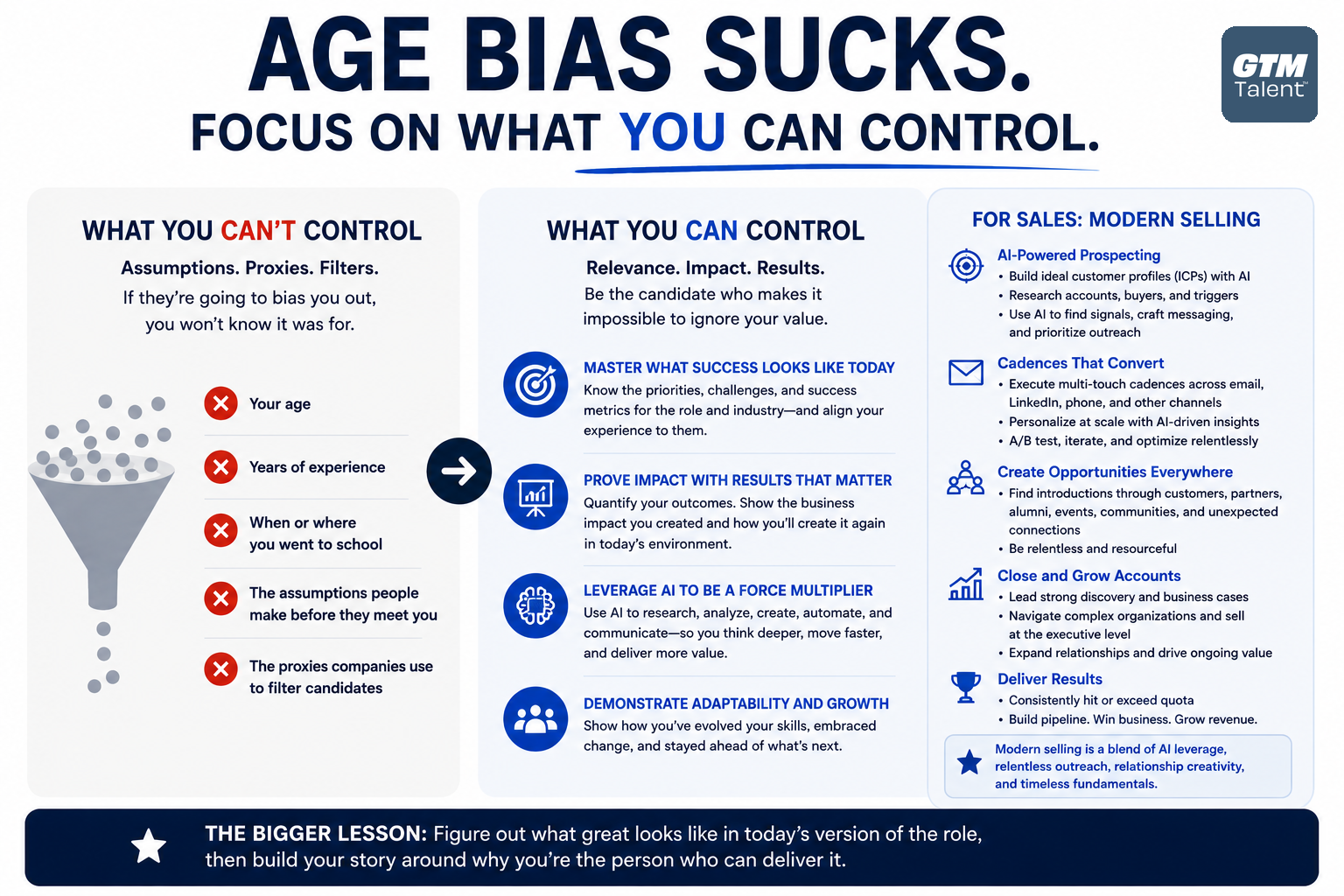
The frustrating reality is that candidates cannot control every assumption someone makes before they ever get in the room. Some companies will filter people out based on age, years of experience, or some other proxy before they ever understand what that person can actually do.
But once you get the opportunity to interview, there is a lot you can control. The question becomes: are you presenting yourself as someone who has accomplished great things in the past, or as someone who understands how to win in today's environment?
So here's my advice to candidates: don't just fight the bias. Out-modernize it.
Understand what great looks like in today's version of the role, because what impressed hiring managers two years ago may simply be table stakes today. The best candidates don't just talk about what they accomplished — they understand what the role requires today and connect their experience to those needs.
Remember when having a polished LinkedIn profile felt like a differentiator? Or when sourcing on LinkedIn gave recruiters an edge? Neither is true anymore. They're table stakes.
What Great Looks Like Today
The same thing applies to sales. The best candidates today typically combine two things.
First, modern prospecting. Can you leverage AI and build and execute a disciplined outbound motion? Multi-touch cadences, thoughtful messaging, personalized outreach — and yes, excellent cold calling.
But a cadence is a tool, not a strategy. The best hunters don't just execute sequences. They create opportunities other people never see. They find introductions at trade shows, through customers, neighbors, alumni, former colleagues, or completely unexpected connections. That resourcefulness — the ability to be relentless and creative — is still one of the biggest differentiators in sales.
Second, the fundamentals that never go out of style: consistent quota attainment, deep industry expertise, executive presence, the ability to navigate complex organizations and sell to senior stakeholders, great discovery skills, strong references, and real stories that prove you can do the job.
About That AI Question
Now, about AI — because I know that's the thing everyone wants to talk about.
Leveraging AI throughout the sales process is table stakes now. And honestly, it's incredible what it can do. You can build an ideal customer profile, research competitors, map an account, prepare for executive meetings, create messaging, develop territory strategies, summarize discovery calls, brainstorm objection handling, and make yourself dramatically more productive.
If you're not doing those things, you probably should be. But don't make the mistake of thinking that's your differentiator.
I keep hearing candidates proudly walk through the AI-powered, agentic GTM workflows they've built. Everyone seems to have their own approach, and honestly, I think it's great. It shows curiosity, initiative, and a willingness to learn. But it's usually not the differentiator candidates may think it is.
If you're interviewing at a midsize or enterprise company, that's not what they're hiring you for. Those organizations already have teams who have built these things. If you are joining a small company, sure — that kind of initiative may genuinely add value. But even there, it's a "by the way," not the headline.
The headline is this: Did AI help you create more pipeline, win more business, and outperform your number? That's what matters.
The Bigger Lesson
Age bias is real, and some companies will never get past the number. But the bigger lesson applies to every candidate, regardless of age: figure out what great looks like in today's version of the role, then build your story around why you're the person who can deliver it.